Concept Art Forest Bts What Dreams May Come Painting
This is a comprehensive guide for accented beginners looking to become started in painting. In writing this, I considered what I would practice if I had to go back and learn painting all over once more.
I have broken the guide into 7 uncomplicated steps you lot tin can follow:
Step 1. Consider Why You Desire to Take upwardly Painting and What You Want to Get out of It
Step ii. Choice Your Medium (Acrylics, Oils or Watercolors)
Stride 3. Go Your Supplies
Step 4. Get Familiar with the Fundamentals of Art
Step 5. Decide What Y'all Desire to Paint Outset
Stride 6. Create Your Start Painting
Step 7. Review and Improve
Bonus Tips
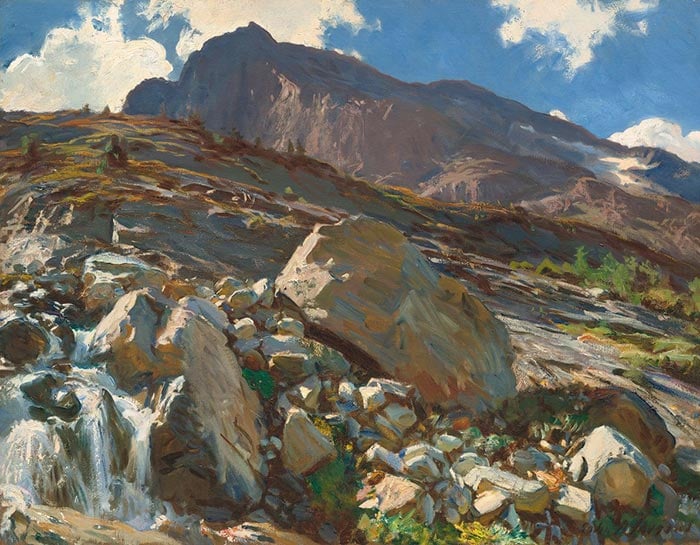
John Singer Sargent, Simplon. Pass, 1911
Footstep 1. Consider Why You Want to Take upwards Painting and What Y'all Want to Go out of Information technology
Before you become out and buy all your new art supplies and starting time throwing paint onto the canvas, yous should consider why exactly yous want to take upward painting and what you want to go out of it.
Your answers will decide how you keep and what yous should focus on learning. I don't believe that there is a static learning path that everyone must follow to master painting. Everyone has unlike tendencies, interests and natural skills which make up one's mind the optimal learning path they should take.
For case, some people exercise not take the patience to sit downwardly and accurately render every tone and detail of a subject. Therefore, they may be better suited to learn color and brushwork from the Impressionists, rather than the rigorous practices of the Russian bookish painters.
Or maybe yous have no interest in breaking into the commercial art world and just want a fulfilling hobby. In that case, you may want to have a more relaxed approach to how you acquire.
Or perhaps you lot want to go a master realist painter like John Singer Sargent or Joaquín Sorolla. To become anywhere near this goal, you would demand to follow a dedicated and rigorous training regime which focuses on drawing and the other fundamentals of painting (color, value, composition, etc).
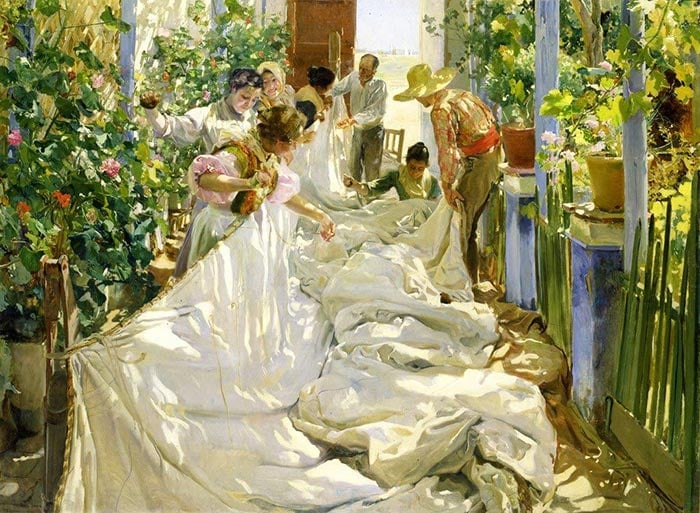
Joaquín Sorolla, Sewing the Sail, 1896
Whatever the instance, it is of import that you have the self-awareness for why y'all are doing this in the first place and what you want to get out of it.
If you have not already, take a second to call back about it. Y'all may fifty-fifty want to share your reply in the comment section at the end of this mail.
Step 2. Choice Your Medium (Acrylics, Oils or Watercolors)
Next, you should decide on a medium to focus on, at least for the short-term. This will allow you to really go a feel for how the medium works, then that y'all can and then pay more attending to the big-picture show aspects of painting, like colour, composition, value, etc.
The major choices are oils, acrylics and watercolours. At that place are some other options, like gouache and watermixable oils, merely I won't bear upon on these in this guide.
But in that location is no right answer hither. Every medium has pros and cons. Here is a crash-class on the different mediums to help you make up one's mind which suits yous:
Acrylics - The Beginner'south Choice
Acrylics are widely favored past those but starting out with painting every bit they are easy to apply and practise non require any special supplies. The downside is they dry very fast.
Acrylics may adjust you if:
- You are a consummate beginner and do not want to worry yourself with the complexities of oil and watercolor painting.
- Y'all desire an easy cleanup time.
- You are painting on a limited upkeep.
- You savour experimenting with mixed media.
- You are sensitive to the harsh chemicals involved with oil painting.
The downsides of acrylics are:
- The paint dries very fast. This ways you but have a express amount of time whilst your pigment is responsive on the sail.
- Some colors darken as they dry (the colors which are lighter tend to have a greater alter).
I personally started with acrylics many years agone. Below is one of my childhood paintings in acrylics.
I eventually moved to oils, after getting frustrated past the quick drying fourth dimension of the paints. Simply acrylics were great for developing a broad understanding of painting whilst I was a beginner.
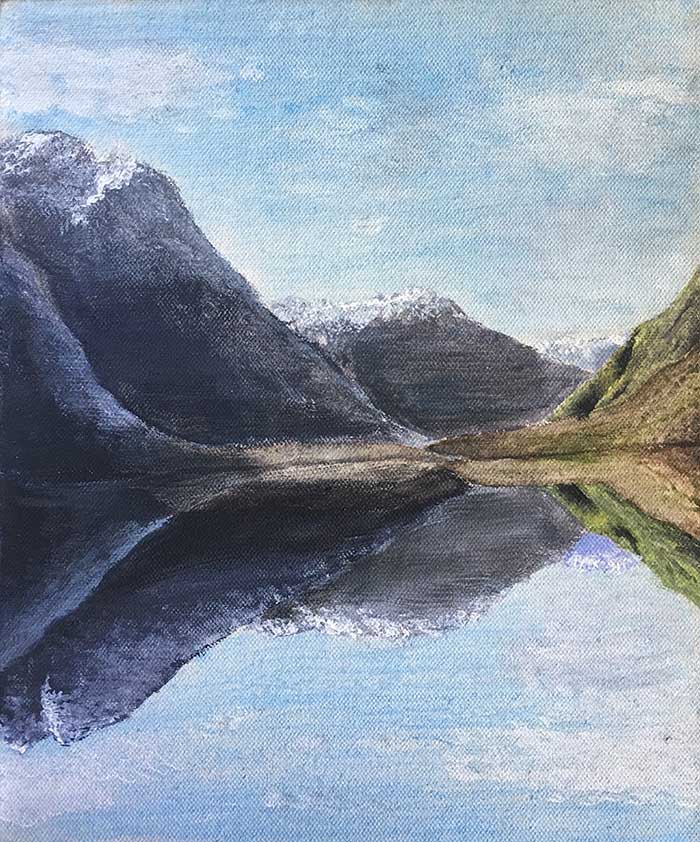
Dan Scott, Early Painting - Mount Reflection
Oils - The Chief'southward Selection
Oil paints are the most widely used medium among professional artists for a number of reasons:
- They are versatile. You tin can vary the drying fourth dimension and consistency of your paint dramatically using paint thinners and additional oil. This allows you to work with a wide range of painting techniques, including blending, glazing and scumbling.
- They were favored by the all-time greats of painting.
- Oil paintings seem to exist held in higher regard by fine art collectors compared to acrylic paintings (there are of course some exceptions to this).
You actually cannot go wrong with oil paints. If you are not sure where to start, I suggest either jumping straight into oils or starting with acrylics with a view of jumping over to oils once you are more than adult. There are some fantastic acrylic painters, only many of them paint in a very contemporary style. The traditional painting techniques which were used by the old masters are much meliorate suited to oil painting.
If you think oil painting is too circuitous for you, and then I urge you to reconsider. In that location are really just a few 'rules' which you need to sympathise in oil painting and the rest is very similar to acrylic painting.
Tip: For those of you who are concerned almost the harsh solvents used in oil painting, like turpentine, then check outordorless solvent. It makes oil painting much more pleasant in my opinion.
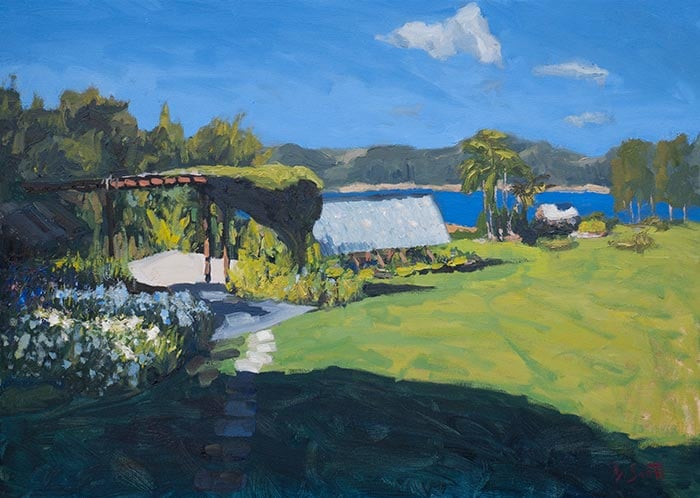
Dan Scott, Secrets on the Lake, 2017
Watercolors - The Untamed Dazzler
Watercolors are generally considered to be the near difficult to choice upward due to the untamed nature of water and the fact you lot are not able to practise much re-working of errors (as the paper tin can only absorb and so much water). Yet, if mastered, watercolors tin can produce stunningly elegant paintings.
For this reason, I recommend you first out with either acrylics or oils before venturing into watercolors. Still, watercolors are a fantastic complement to your acrylic or oil painting every bit they train a unlike skillset.
For example, John Singer Sargent was famous for his meticulous portraits using oils, but he used watercolors to paint impressionist and loose landscapes and portraits. These watercolor paintings probably felt very refreshing for Sargent who would have been accustomed to the lengthy and tedious portrait painting sessions.
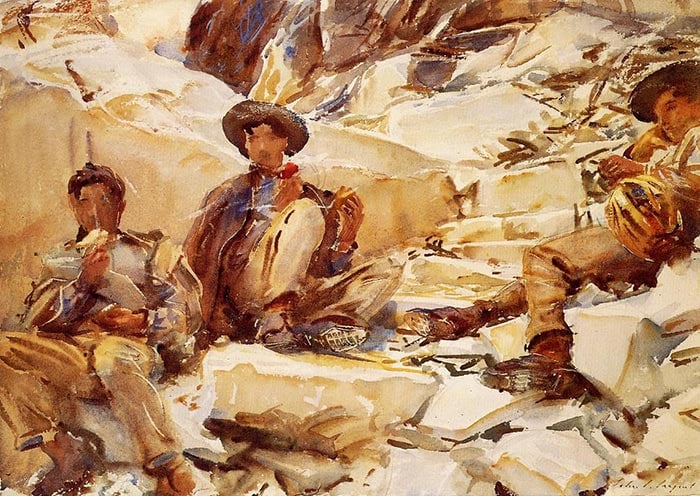
John Singer Sargent, Carrara, Working, 1911
Which Should You Go With?
There is no correct respond here, merely if you are just starting out in painting so I recommend y'all starting time with acrylics or oils. But feel complimentary to start with watercolors if you are up for the challenge.
Also, this is not to say you must choose a medium and ignore the rest. I encourage yous to try all different kinds of mediums, simply have one which y'all really focus on and get familiar with. Information technology is ameliorate to exist a master of i medium, than be average at all mediums.
Step 3. Go Your Supplies
It'southward fourth dimension to stock upwardly on art supplies. But brand certain you read all of this department showtime earlier yous starting time ownership every type of brush or every color of paint – you lot do not really need that much stuff!
The supplies you get volition vary depending on the medium you lot decide to get with. In a broad sense, all you need is:
- An easel to hold your artwork;
- Canvas (for acrylic or oil painters) or paper (for watercolor painters);
- A palette for colour mixing;
- Brushes (suitable for your called medium);
- Palette knives;
- Paints;
- Solvent (if oil painting); and
- Paper towels (for wiping your brush betwixt strokes).
That is information technology really. Painting can be as uncomplicated as you want to make it.
You volition be able to find all this at your local art store. If yous are an accented beginner, it may be worth starting with a beginner packet which includes most of the basic supplies you would need. Yous can so upgrade afterward.
My main suggestion is to keep it simple and purchase quality where information technology matters, like your brushes, canvas and paint (a premium quality easel will not brand you a improve painter).
Equally Richard Schmid wrote in his book Alla Prima:
"If Michelangelo had possessed only a broom and a saucepan of mud, he could nevertheless take painted the Sistine Chapel ceiling, and it would have been just as much of a masterpiece!"
As for the colors, I suggest yous start with a limited palette which has ruby, blue, yellow (the principal colors), white and an earth tone similar raw umber. Here is a good starter palette:
- Cadmium ruby-red
- Ultramarine bluish
- Cadmium yellow
- Titanium white
- Raw umber
I go into more than item on painting supplies in this guide. You can also see what I use and recommend on the supplies folio.
Step 4. Get Familiar with the Fundamentals of Art
I am a big believer in learning efficiently rather than just putting in fourth dimension for the sake of it. You could practice for years and hardly better if yous don't know what you are doing. This is where the fundamentals of fine art come into play - color, value, composition, edges, brushwork and technique.
These are what I consider to exist the core pillars of painting. It is of import that y'all become familiar with them early, equally they will help you understand what exactly is going on when your brush hits the canvas. Learning these fundamental areas will do good every stroke you make.
Here is a summary of the fundamentals:
Color: Nosotros are all familiar with colour, then much so that we have it for granted. Few people fully sympathize and capeesh what color actually is.
I find it easier to comprehend color in terms of hue, saturation and value. These are the three elements which make up a color.
Hue refers to where a color is located on the colour wheel. Red, blue, yellow, light-green – these are all different hues. Saturation refers to how rich, intense or vibrant a color is. Value refers to how light or night a color is.
Learn these three terms and larn them well, as you lot will come across them with every artwork yous create.
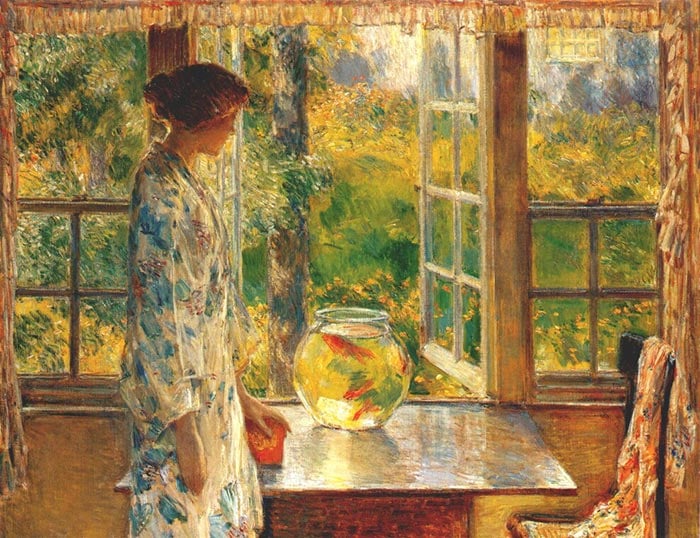
Childe Hassam, The Aquarium with Gold Fish, 1912
Value: Value is an element of color, merely it is by and large considered every bit a carve up fundamental area due to its importance to painting. Every color - red, bluish, green, orange, purple - has an underlying value somewhere between white and black. For instance, take the following painting by Claude Monet.
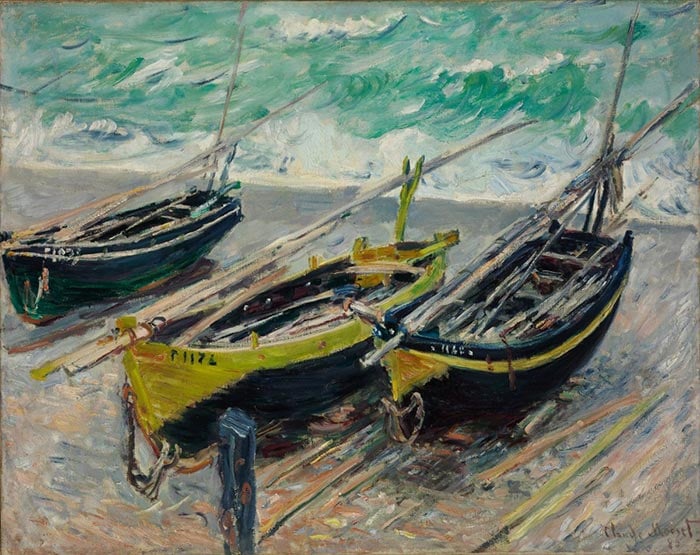
Claude Monet, Fishing Boats, 1886
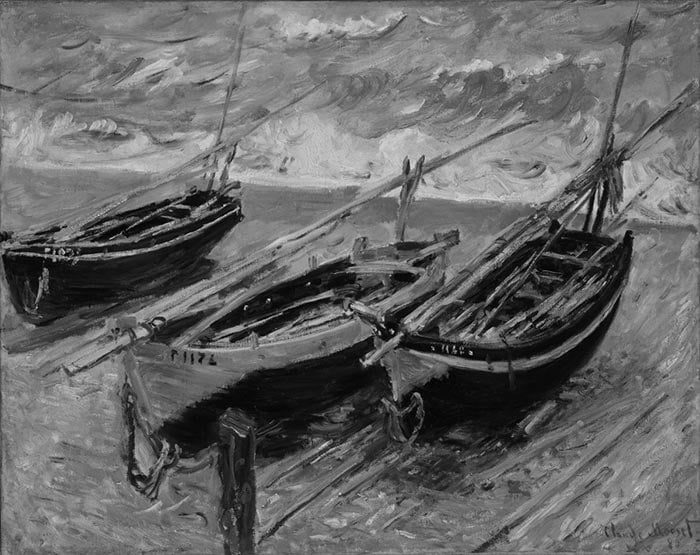
If I accept color out of the equation, we are left with goose egg but the different values ranging from light grayness to virtually black. This painting has a strong value structure, equally y'all tin can conspicuously make sense of it without color. A strong value structure is non essential by any means (just look at many of the groovy Impressionist paintings) but it certainly helps in giving your painting a solid foundation. If y'all paint with accurate values, and then you lot have more leeway with your utilise of brushwork, color and particular.
Composition: You will hear all kinds of complex terms, "rules" and theories
used to explicate composition in painting. Things like…
Focal bespeak
Rule of thirds
Gilt hateful
Horizon line
Leading lines
Harmony
Rhythm
Move
Balance
…. and and then on.
Simply really, in that location are simply two questions which are important for
creating nifty compositions.
What do you desire to say?
How are y'all going to say it?
That is it. None of the other stuff matters all that much.
Let's dive into those questions a bit deeper…
What do you want to say? In other words, if your painting could
speak, what would it say? If y'all don't know, then yous are working
blind.
Too, this does not demand to be some deep and philosophical
argument. It could be as simple equally…. "I desire to capture the mode lite is bouncing off the river surface".
But it is important that you know what y'all want to say - a big thought you want to communicate.
How are you going to say information technology? Or, how are you going to adjust all
the elements in your painting to piece of work in harmony and communicate
what you lot want to say. Think of all your individual strokes, shapes, lines, colors and textures as tools at your disposal.
(Boosted resource: Composition breakup checklist.)
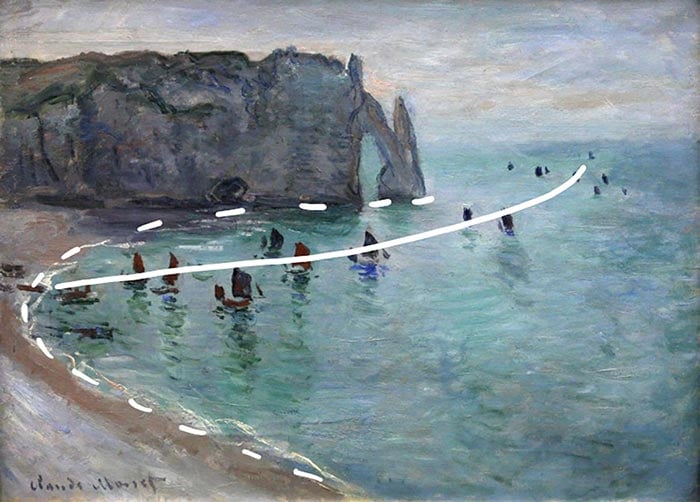
Claude Monet, Etretat the Aval Door Fishing Boats Leaving the Harbour, 1885
Edges: An edge is what separates two shapes. Information technology can exist either hard, soft or lost. Hard edges have a clean transition betwixt the two shapes; soft edges accept a smoothen transition; and lost edges are and so smooth you can barely see them.
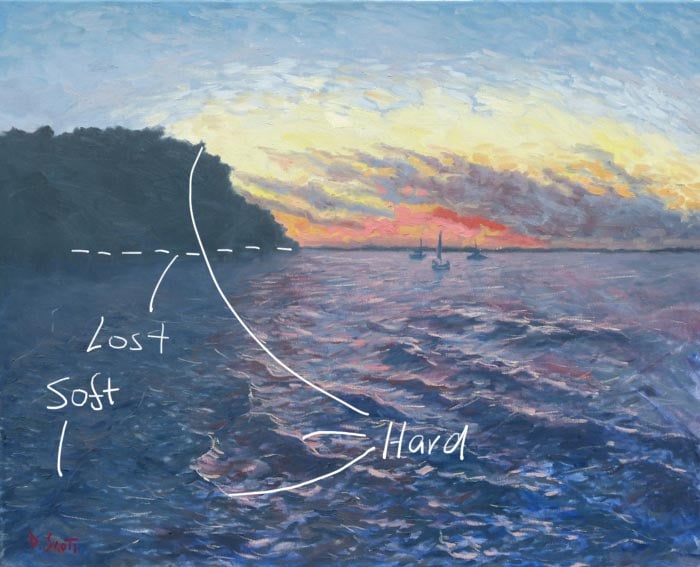
Dan Scott, Iii Boats at Kingfisher Bay, 2016
Brushwork: The physical marks left by your brush (or your palette knife, finger, or anything else you lot use to pigment with). This is an overlooked aspect of painting, which is odd considering it is what makes a painting look like a painting. If non for brushwork, we may also merely take a photograph, or exercise digital art rather than traditional fine art.
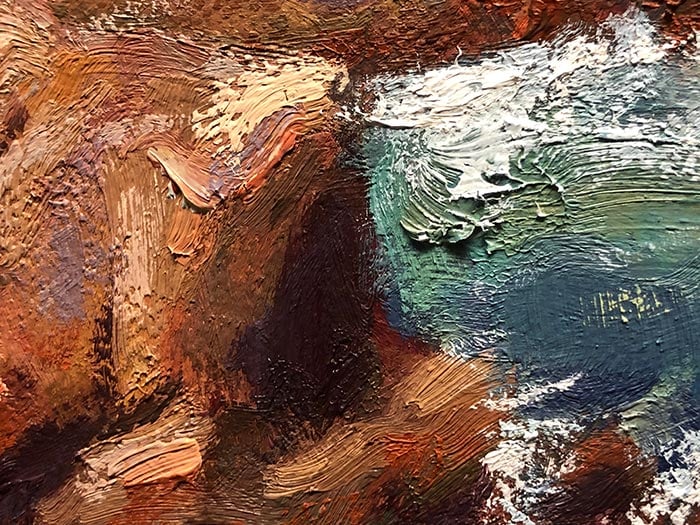
Dan Scott, Honeymoon Bay, Tasmania, 2019 - Close-Up
Technique: How well you are able to perform certain deportment. Good technique will develop over time as y'all gain experience and become more comfortable with your brush and paints. But you need to be careful of any bad habits which y'all may pick upwardly forth the way. This could be the way you lot concur your brush, or the types of strokes you make. Bad habits can be incredibly difficult to ready later you lot take been practicing them for a number of years.
To develop skillful painting technique, I advise you carefully watch masters paint. Notice how they hold their brush, how they apply paint to canvas, how they mix colors, and so on.
(I go into much more particular on the fundamentals in my Painting University course.)
Step 5. Decide What You Desire to Paint Starting time
Ane of the nigh challenging aspects of painting happens earlier yous pick upwards your brush – selecting a subject to paint.
The perfect subject should be inspiring and challenging. You should experience the need to pigment information technology.
Here are some questions to help you make up one's mind if a subject is worth painting:
- Is there a "big why"? A single thought which makes y'all want to paint it.
- Is there a articulate and identifiable color harmony?
- Does the subject have an interesting design (think about the arrangement of shapes, forms, lines and colors)?
- Is at that place annihilation yous tin do to amend on the subject field?
- Are you capable of painting information technology?
- Exercise you have the supplies required to paint it?
- What problems volition you encounter painting information technology?
- Does the subject area provide you with opportunities to challenge yourself and demonstrate your abilities?
- Does the subject field inspire yous?
- Can you see a finished painting at the stop of it all? If so, practise you like what y'all encounter?
Enquire yourself these questions next time you are not sure if a subject field is worth painting.
Note: These questions are not necessarily there to be answered, but rather to make you question and explore the subject field before you lot commit to something more.
As an example, the following photograph is something I would like to paint. Here is why:
- I love the contrast between the light greens getting hit by light and the foreground in shadow. This is what I would focus on capturing if I were to paint it - mybig idea.
- The composition is interesting.
- There is a pleasing balance betwixt agile and quiet places.
- I tin see myself painting this.
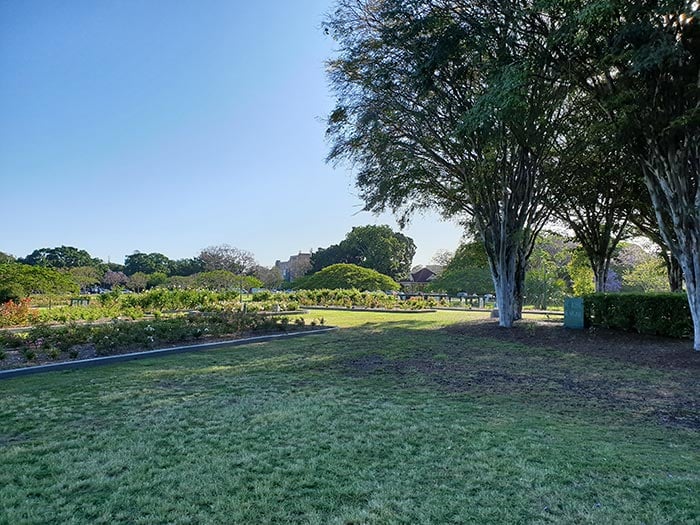
Step 6. Create Your Get-go Painting
Yous are now ready to create your first painting. Merely a word of warning though, it will be harder than it looks!
The master artists make it look effortless, but don't forget they have been painting for many years, even decades in some cases.
My main suggestion for your first painting is to start general; attempt to capture your initial impression of the subject area. Recall nigh the subject field in terms of shapes and colors. Y'all tin and then refine the painting and add more detail.
Equally an case, I volition run you through one of my paintings. Below is the reference photo I painted from.
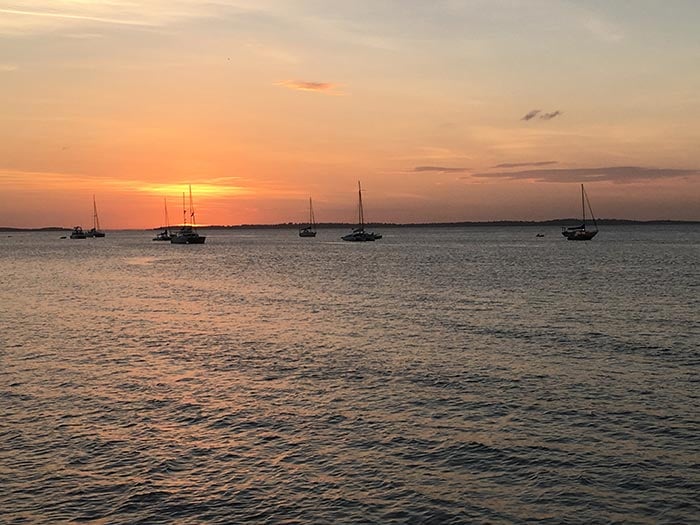
I started by loosely painting in the major colors and shapes with a low-cal wash.

I then started to build upward the grade and structure.
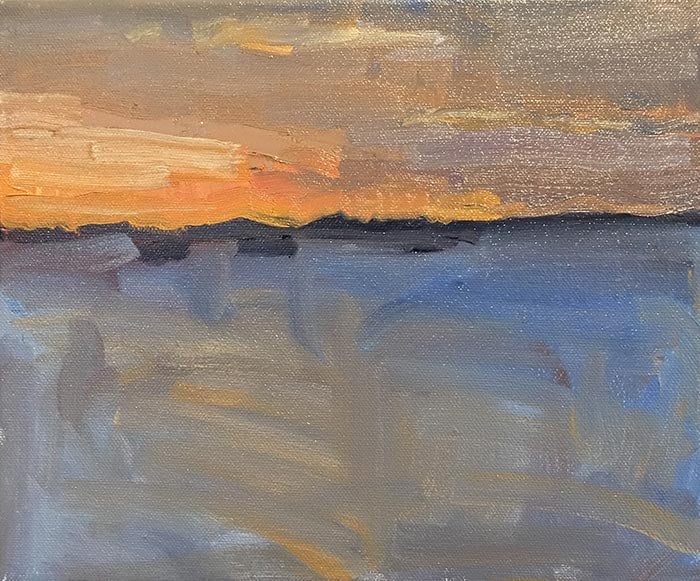
The finished painting is below. This should give you an idea of how crude and general I start a painting. Of course, some subjects require more than delicate attention, merely that is something you lot need to consider on a case by case basis.
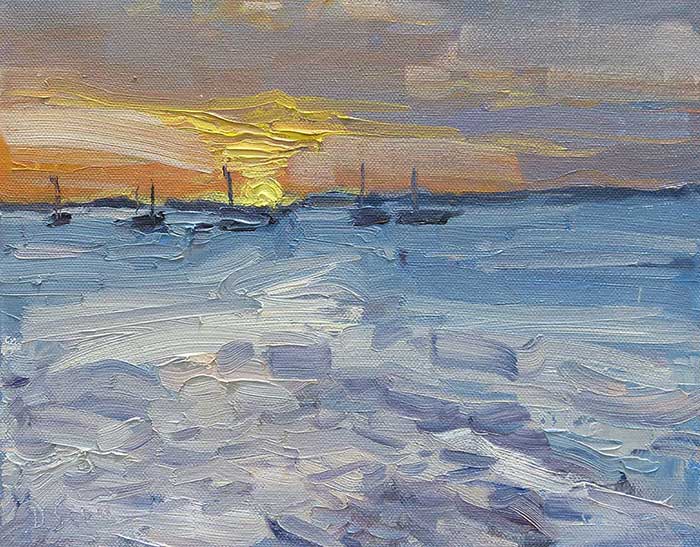
Dan Scott, Dusk Study, Kingfisher Bay, 2017
You can see more step-by-step paintings on the video folio. Here is an instance of a elementary mural painting:
Tip: Be proud of your beginning artworks, even if they exercise not turn out as planned. 1 day, you will look back and come across how far yous have come up. Beneath is 1 of my early on paintings from when I was a kid. Non perfect by any ways (I even forgot to paint the right side of the body of water...) but it reminds me of how I started.
Likewise, don't compare your first few paintings to the works of other artists. Well-nigh people do not share their early on or failed works; yous just see their all-time.
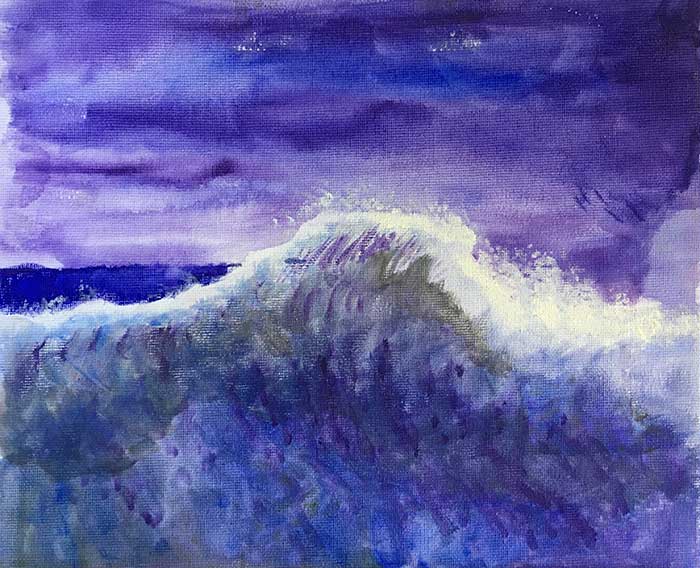
Dan Scott, Early Painting - Impressionist Wave
Step 7. Review and Improve
Once you accept created your first painting, it is time to take a step dorsum and review what went right, what went wrong and where you can improve. Unless you are some kind of prodigy, your first painting probably won't exist a masterpiece but that is ok. Everyone starts equally amateurs, fifty-fifty the masters.
Look at your painting like an art critic. Here are some questions to ask yourself:
- What aspects of the painting exercise I like?
- What aspects would I change?
- What is the mood of the painting?
- What is my first impression of the painting? I suggest you have a break from looking at the painting for a day or two, then come up back to it.
- Do the colors work, or practise they appear muddy?
- Is the composition pleasing?
- Is at that place any visible brushwork which adds to the painting?
- Have I captured the overall likeness of the subject?
- Is at that place anything in particular which irritates me virtually the painting?
- Take I captured the perspective accurately?
- Does the painting announced cohesive?
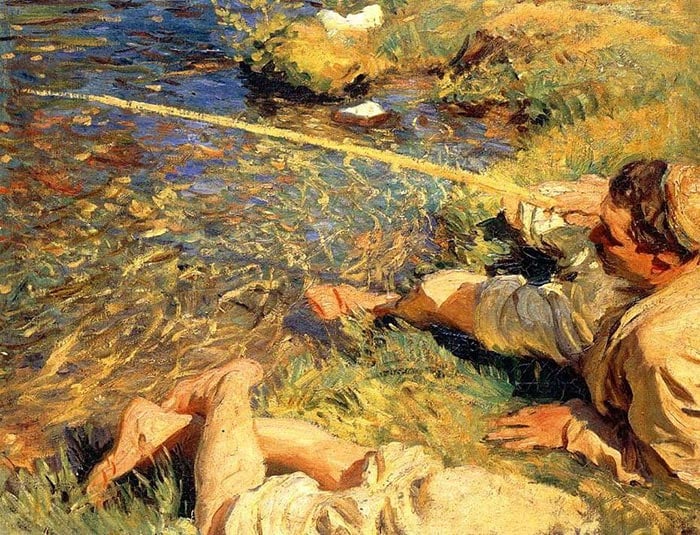
Fisherman in Valle d'Aosta, John Vocalist Sargent, 1907
Bonus Tips
- Don't worry about what other people think. Take criticism only do not permit it be the main driver for what y'all practice.
- Appoint in the community – enter competitions, visit galleries, talk to other artists, read creative person blogs, subscribe to artist newsletters, etc. The more than engaged yous are, the more inspired yous will be.
- Try not to be intimidated by artists who are more skilled. In that location will e'er exist someone more skilled, experienced, knowledgeable or technical than you. Look to them for inspiration, rather than exist intimidated past them.
- Don't worry that much about developing a memorable or unique mode if you are just starting out. It will develop over time with experience.
- Focus on the fundamentals - color, value, limerick, edges, brushwork and technique. These areas will benefit every stroke yous make and will compound your level of comeback over time.
- Enquiry the masters who came before usa. Learn virtually how they lived, studied and worked. This will provide you lot with a abiding source of inspiration and knowledge.
- Don't be afraid to experiment and effort new things.
- Exist careful of gimmicky techniques, secrets, rules or methods.
- Be open-minded and flexible with how you larn.
- The only secret to becoming a corking painter is to acquire, practice, review and improve.
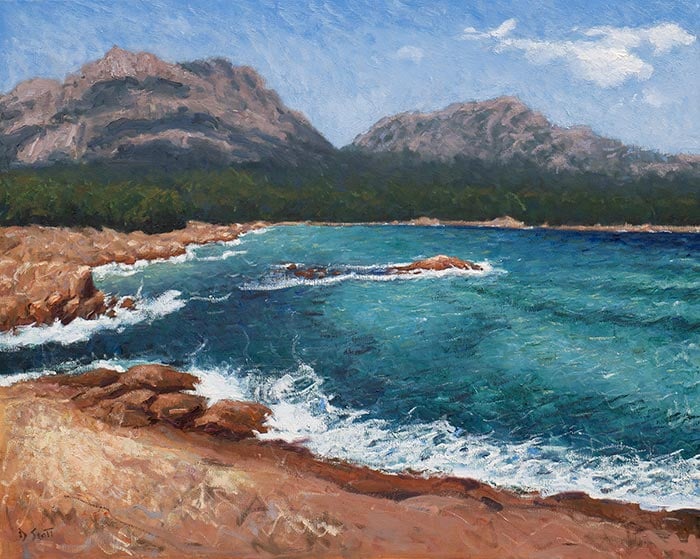
Dan Scott, Honeymoon Bay, Tasmania, 2019
At present over to Yous
In the first office of this guide, I asked y'all to consider why you want to take up painting and what you desire to become out of it. If you take not already, I urge you to think near this for a moment. Yous tin share your thoughts in the annotate section below.
Thanks for Reading!
Thanks for taking the time to read this postal service. I appreciate information technology! Feel free to share with friends. If you want more painting tips, check out my Painting University course.
Happy painting!

Dan Scott
Draw Paint Academy
Source: https://drawpaintacademy.com/painting-for-beginners/
0 Response to "Concept Art Forest Bts What Dreams May Come Painting"
Postar um comentário